


rayman@sdrayman.com
0086-132-0538-3163
Monitors all feature screens and connecting leads for vital‑sign monitoring, yet scenarios impose totally different requirements:
Ward‑use monitors: Stationary at bedside for long‑term continuous monitoring, prioritizing stability and comprehensive parameters.
Transport emergency monitors: Designed for mobile use under bumpy conditions; compact, rugged and fast‑to‑deploy are key.
Veterinary monitors: Built for animals such as dogs and cats. They feature modified heart‑rate ranges, lead configurations and alarm thresholds compared with human‑oriented devices.
Using a ward‑use monitor in an ambulance will cause problems like excessive weight and insufficient battery life. Deploying human‑use monitors in pet clinics brings mismatched heart‑rate ranges and incorrect alarm parameters, making the device clinically invalid.
| Comparison Item | Standard Ward‑use Model | Transport Emergency Model | Veterinary Model |
|---|---|---|---|
| Application Scenarios | In‑patient wards, ICU, CCU for fixed bedside deployment | Ambulances, emergency transfers, intra‑operative patient movement between operating rooms | Pet hospitals, animal clinics, veterinary operating rooms |
| Device Weight | Relatively heavy, seldom moved | Lightweight, with carry‑handle / stretcher‑mountable | Medium weight, for countertop use in pet hospitals |
| Battery Life | Backup battery for several hours | Long‑duration, continuous operation for 4‑8 hours | Standard battery performance meets requirements |
| Ingress Protection | Regular dust‑proof & moisture‑resistant | Enhanced shock‑proof and dust‑proof for bumpy environments | Standard grade, easy to clean and disinfect |
| Heart‑rate Range | Adult / Pediatric: 6‑300 bpm | Same as human clinical standard for adults & children | Wide animal‑specific range: 50‑600 bpm for dogs & cats |
| NIBP Cuffs | Adult & pediatric cuffs | Adult & pediatric cuffs with fast inflation | Special‑size cuffs for dogs & cats for different body sizes |
| SpO₂ Probe | Adult finger‑clip / pediatric wrap‑style | Adult finger‑clip, shock‑resistant & durable | Veterinary tongue / tail clip probes for animals |
| Monitoring Parameters | ECG, RESP, SpO₂, NIBP, TEMP; expandable for IBP / EtCO₂ | Core vital‑sign parameters, optimized for portability | ECG, SpO₂, NIBP, TEMP, veterinary‑adapted algorithms |
| Alarm Functions | Multi‑level audio‑visual alarm, arrhythmia analysis | High‑visibility fast‑response alarms for noisy mobile environments | Preset veterinary alarm thresholds; one‑toggle dog / cat mode |
Design Focus: Large‑screen display, full parameter sets and stable long‑time operation.
Target Customers:
General‑hospital inpatient wards and cardiology wards
Public‑hospital inpatient departments in developing countries for bulk procurement
Private‑hospital inpatient‑ward equipment upgrades
Key Procurement Considerations:
Sufficient screen size for clear visibility from nurses’ stations
Support for expanded parameters (invasive blood pressure IBP, end‑tidal CO₂ EtCO₂)
Network‑connectable to central monitoring systems
Proven stability via continuous aging testing before factory delivery
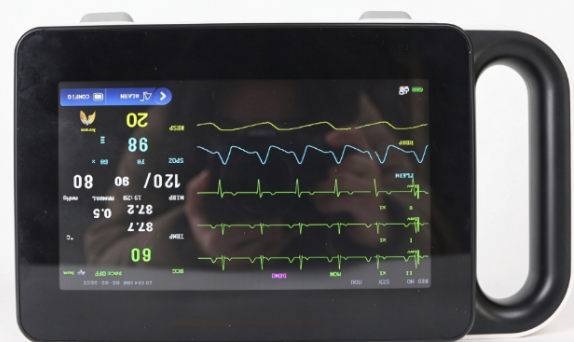
Design Focus: Portability, shock resistance, long battery runtime and quick mounting for ambulances.
Target Customers:
Emergency‑response centers and ambulance fleets
Hospital emergency departments and inter‑OR patient transfers
Field medical care and emergency‑relief projects
Public‑site AED‑matching monitoring devices in airports, stations, etc.
Key Procurement Considerations:
Lightweight unit with carry‑handle or bracket‑mountable for stretchers / ambulances
Battery capacity covering full transfer missions; supports vehicle‑mounted charging
Good shock resistance to preserve measurement accuracy under ambulance vibration
Fast boot‑up for immediate monitoring in emergency situations
Loud alarm volume to cut through high‑noise transport environments
Design Focus: Extended heart‑rate range, animal‑specific cuffs & probes, one‑click dog / cat mode switching.
Target Customers:
Pet hospitals and chain veterinary clinics
Livestock farms and veterinary stations
Zoos and wildlife rescue centers
Key Procurement Considerations:
Heart‑rate range must suit animals: normal dog heart rate 60‑160 bpm; cat heart rate 120‑240 bpm. The 300 bpm upper limit of human‑use monitors is insufficient for small animals.
Multiple NIBP cuff sizes for different animal body circumferences; incorrect cuff width produces unreliable readings.
Veterinary‑specific SpO₂ tongue‑clip or tail‑clip probes; human finger‑clips cannot fit animal tongues or ears.
Pre‑configured profiles for dogs, cats, rabbits etc. for automatic alarm‑threshold adjustment without manual veterinary setup.
Smooth surfaces for easy wiping and disinfection against pet hair and bodily fluids.
Important Reminder: Veterinary monitors shall never substitute human‑use units and vice versa. Human‑use monitors are programmed for human physiology, with limited heart‑rate upper bounds, human‑targeted NIBP algorithms and alarm thresholds. When used on animals, they deliver inaccurate measurements and frequent false alarms and are clinically unusable. Exporters must confirm whether buyers require human‑use or veterinary versions, and ensure corresponding certification documentation.
Answer these three questions to lock in the correct model:
Where will the device be deployed? Fixed ward setting → ward‑use model; ambulance / mobile transport → transport emergency model; pet clinic → veterinary model.
Who is the monitored subject? Human adults / children → human‑use monitor; dogs, cats and other animals → veterinary monitor. Never substitute with human‑use equipment.
Are expanded parameters required? ICU / operating‑room needs for IBP, EtCO₂ → select expandable ward‑use variant. Core vital‑sign parameters suffice for emergency‑transport scenarios.
When exporting patient monitors, matching the model to end‑user scenarios matters more than pursuing high‑end specifications. Satisfied end‑users bring repeat orders and referrals.
Rayman supplies a full portfolio of ward‑use, transport‑emergency and veterinary monitors with flexible configuration options and OEM support, together with complete CE and other export certifications.
Overseas medical‑device distributors, emergency‑project procurement teams and pet‑medical groups are welcome to enquire for product brochures and quotations. Rayman can recommend optimal solutions aligned with your target market and clinical scenarios.

Contact: Sophy Gee
Phone: 0086-132-0538-3163
Tel: 0086-132-0538-3163
Email: rayman@sdrayman.com
Add: No.279, Longquan Road, High-Tech District, Taian City, Shandong Province
CopyRight 2016-2026 Shandong Rayman Medical Systems Co., Ltd POWERED BY YUKE Sitemap

We chat
