


rayman@sdrayman.com
0086-132-0538-3163
IntroGlobal healthcare resources are shifting away from concentration in large urban tertiary hospitals toward grassroots‑level deployment and mobile‑medical‑service expansion. The development of primary‑care capacity and the popularization of portable wireless medical devices represent two of the clearest growth drivers for the global medical‑device market over the next five years. This article sorts out the underlying driving forces behind these two trends, high‑growth product categories and regional market opportunities, to help foreign‑trade enterprises define their product‑layout strategies.
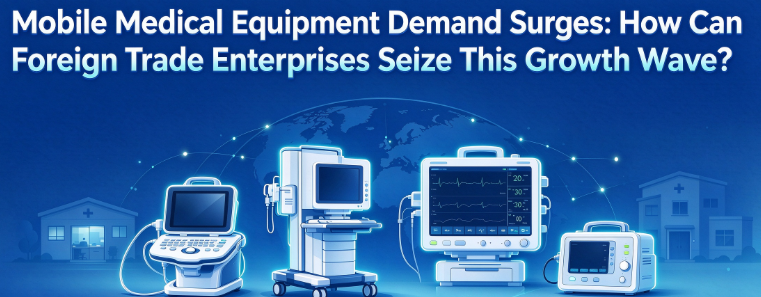
In the post‑pandemic era, governments and international organizations worldwide have fully recognized that insufficient primary‑care capacity forces large numbers of mildly ill patients into major hospitals, overwhelming healthcare systems. Accordingly, both upgrades to family‑doctor networks in developed economies and the construction of township‑level health facilities in developing countries are accelerating.
Key driving factors:
Population aging: The global population aged 65 and above keeps growing, fueling surging demand for chronic‑disease management, home‑based care and community follow‑up visits; primary‑care first‑contact consultation has become an essential requirement.
Payment‑side pressure: Healthcare payers worldwide implement cost‑control policies and encourage “primary‑care first‑contact plus two‑way patient referral”, boosting budget allocations for primary‑care facility equipment.
International‑organization aid programs: WHO, the World Bank, the Global Fund and other bodies keep funding primary‑care facility upgrades in developing nations, triggering large‑volume procurement of DR systems, ultrasound scanners, patient monitors and other devices.
Decentralized diagnosis and treatment: Miniaturized, intelligent imaging and laboratory equipment enables grassroots‑level medical institutions to deliver independent diagnostic services.
Traditional medical equipment relies on fixed dedicated hospital rooms. By contrast, mobile ultrasound units, portable monitors and wireless point‑of‑care testing devices break such constraints. Mobile medical devices are expanding the boundaries of healthcare services for ambulances, community outreach clinics and remote‑area medical missions.
Core driving forces:
Technological maturity: Advances in micro‑sensors, flat‑panel detectors and wireless communication have enabled portable devices to deliver performance comparable to desktop counterparts.
Expanded application scenarios: Clear demand for portable devices emerges in emergency rescue, field medicine, telemedicine consultation and home‑care settings.
Cost reduction: Mature supply chains make portable devices more affordable for grassroots clinics and private practitioners.
Telemedicine integration: Data collected by mobile devices can be directly uploaded to the cloud to support remote consultation and AI‑assisted diagnosis.
表格
| Product Category | Growth Rationale | Typical Application Scenarios |
|---|---|---|
| Portable / Mobile Ultrasound | Rapid adoption of hand‑held and pen‑type ultrasound scanners, partially displacing desktop‑device demand | Emergency treatment, bedside examination, obstetric follow‑ups, veterinary practice, community outreach clinics |
| Multi‑parameter Patient Monitors | Rising demand for grassroots‑ward observation, emergency‑department observation and in‑transit patient monitoring | Township‑hospital wards, ambulances, post‑operative recovery units |
| Digital DR / Mobile DR | Digital transformation of radiology departments at grassroots facilities; mobile DR adapts to complex working environments | Township health centers, makeshift hospitals, field medical units, ICU bedside radiography |
| Electrocardiograph (ECG) | Portable 12‑lead / 3‑lead ECG machines paired with remote diagnosis for cardiology screening at decentralized care sites | Community clinics, physical‑examination centers, family‑doctor home visits |
| Defibrillators / AEDs | Policy‑driven public‑site emergency‑equipment deployment; bulk procurement for grassroots emergency stations, schools and airports | Emergency‑response centers, public venues, senior‑care facilities, community hospitals |
| Biochemistry Analyzers | Compact fully‑automatic biochemistry analyzers equip grassroots laboratories with routine‑testing capabilities | Township health centers, private clinics, physical‑examination institutions |
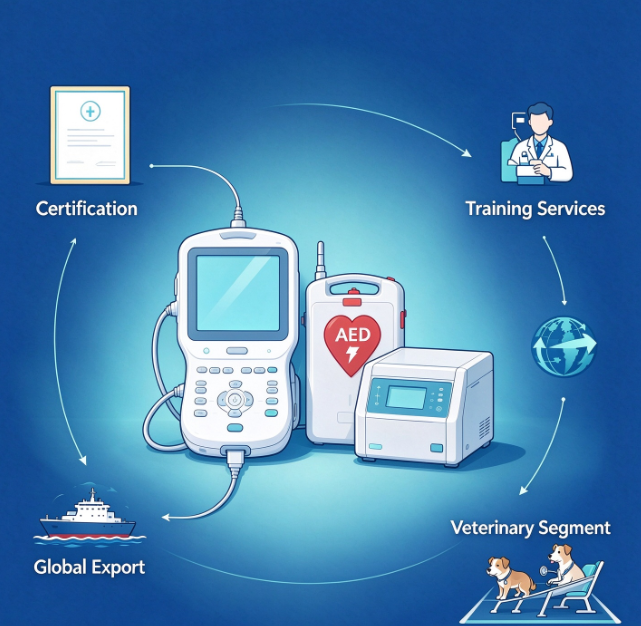
In addition, medical‑tourism development across the Middle East drives procurement of high‑end equipment by private hospitals. European clinics are renewing their installed base with energy‑saving, digitally‑enabled devices, representing another noteworthy niche market.
Future incremental growth lies not in flagship high‑end devices for large tertiary hospitals, but in practical, user‑friendly and cost‑effective equipment tailored for grassroots‑care scenarios. Enterprises should prioritize portable ultrasound, bedside monitors, mobile DR and compact laboratory‑testing devices in product planning. Meanwhile, networking capability — compatibility with tele‑diagnosis platforms — has become a new key criterion for buyer selection.
Many grassroots‑care projects are government‑led tenders or international‑organization aid initiatives with strict certification requirements. Secure certifications including CE (EU), FDA (US), ANVISA (Brazil), COFEPRIS (Mexico) and SABER (Saudi Arabia) for target markets. Without valid certifications, suppliers cannot even qualify for bidding.
Grassroots‑care customers are often less concerned about purchasing equipment itself than about insufficient user training and lack of after‑sales maintenance support. Suppliers offering integrated packages combining equipment, user training, remote technical support and spare‑parts supply gain a clear competitive edge. Value‑adding deliverables such as multi‑language user manuals and video tutorials, alongside remote fault diagnosis, create critical differentiation.
Booming global pet‑economy growth fuels faster‑than‑human‑medical‑market demand for veterinary ultrasound, veterinary monitors and veterinary X‑ray systems. This segment features relatively moderate market competition and healthier profit margins, making it a viable direction for product‑line extension.
The global medical‑device market is undergoing structural transformation: market focus is shifting away from high‑end tier‑one urban hospital markets toward grassroots‑level and mobile‑care “base‑of‑pyramid” markets. For Chinese medical‑device exporters, enterprises that best satisfy grassroots‑care requirements for cost‑effectiveness, ease‑of‑use and durability will capture larger market shares amid this global primary‑care‑infrastructure‑building wave.
We continuously focus on exports of grassroots‑care and portable medical devices. Our product portfolio covers portable ultrasound scanners, multi‑parameter patient monitors, digital DR systems, ECG machines and more. We hold complete export qualifications and support OEM cooperation. Overseas medical‑device agents and project‑procurement buyers are welcome to connect for business discussions.
Contact: Sophy Gee
Phone: 0086-132-0538-3163
Tel: 0086-132-0538-3163
Email: rayman@sdrayman.com
Add: No.279, Longquan Road, High-Tech District, Taian City, Shandong Province
CopyRight 2016-2026 Shandong Rayman Medical Systems Co., Ltd POWERED BY YUKE Sitemap

We chat
